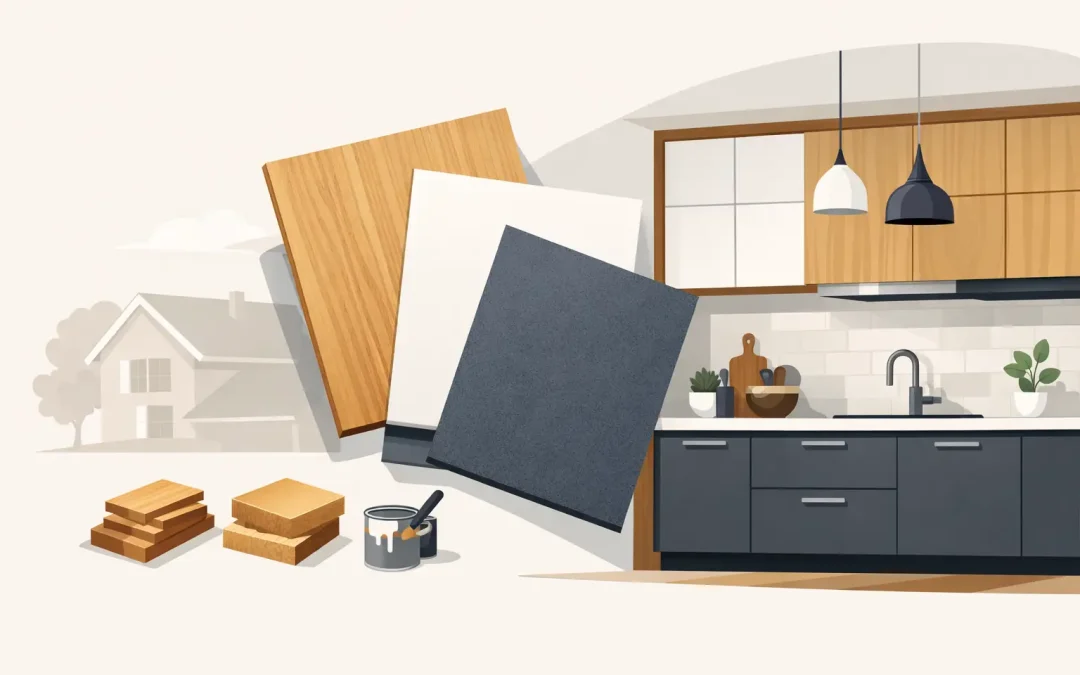
A cabinet can look like solid wood from across the room and still be built from several different materials underneath. That is why homeowners searching “what is kitchen cabinets made of” need to look beyond the door style and color. Cabinet material affects how well your kitchen holds up to humidity, daily use, heavy dishes, and the demands of a busy family home.
The right choice is rarely one material used everywhere. Well-planned kitchen cabinetry often combines durable cabinet boxes, stable door panels, solid fastening points, and a finish that fits the room’s use and the homeowner’s budget. Knowing where each material performs best helps you make a practical decision before your renovation begins.
What Are Kitchen Cabinets Made Of?
Kitchen cabinets are usually made from engineered wood products, natural wood, or a combination of both. The main components are the cabinet box, doors and drawer fronts, drawer boxes, shelves, and face frames or edge treatments. These parts do not all need the same material.
For example, a quality cabinet may have a plywood box, solid hardwood face frame, MDF painted doors, and hardwood drawer boxes. That combination is not a shortcut. It can be a smart way to balance strength, appearance, and cost where each matters most.
Cabinet boxes
The cabinet box is the structure behind the doors. It supports countertops, holds shelves, anchors hinges, and carries the weight of pots, dishes, and pantry items. Plywood and particleboard are the most common box materials. Better construction also depends on the thickness of the panels, the strength of the joints, the cabinet back, and how securely the cabinets are installed to the wall.
Doors and drawer fronts
Doors and drawer fronts create the visible finish of the kitchen, so material choice is especially noticeable here. Solid wood, MDF, plywood, and thermofoil-wrapped engineered wood are all common. A painted shaker-style door is often made from MDF because it has a smooth, consistent surface. A stained door with visible grain is more likely to use solid wood or wood veneer.
Shelves and drawers
Shelves need enough rigidity to avoid sagging under everyday weight. Drawer boxes are often built from solid hardwood, plywood, or durable engineered materials. Full-extension, soft-close drawer hardware can make a major difference in daily function, but it performs best when attached to a well-built cabinet structure.
Plywood Cabinets: A Strong Choice for Cabinet Boxes
Plywood is made from thin layers of wood veneer glued together with alternating grain direction. This layered construction gives it good strength and stability. It is commonly used for cabinet sides, bottoms, shelves, and backs, especially in higher-quality semi-custom and custom kitchens.
A major benefit of plywood is its ability to hold screws well. That matters at hinge locations, drawer-slide mounting points, and areas where cabinets are fastened together or secured to the wall. Plywood also generally handles occasional moisture exposure better than standard particleboard, although no wood-based cabinet material should be left wet.
Not all plywood is equal. Cabinet-grade plywood has a smoother face and more consistent interior layers than lower-grade sheets. When comparing quotes, ask about the thickness of the plywood and whether the cabinet interior is finished. A 1/2-inch panel, a 3/4-inch panel, and a thin panel with a decorative finish can perform very differently over time.
The trade-off is cost. Plywood cabinets typically cost more than particleboard-based cabinets. For homeowners investing in a long-term kitchen renovation, the added strength can be worthwhile, particularly for large kitchens, wall cabinets storing heavy dishes, and base cabinets that will support stone countertops.
Particleboard: Common, Affordable, and Worth Evaluating Carefully
Particleboard is made from wood particles and resin pressed into sheets. It is widely used in stock and entry-level cabinetry because it is flat, uniform, and more affordable than plywood. When it is properly laminated or coated and kept dry, it can serve well in many kitchens.
Its limits become more apparent around water and heavy loads. Particleboard can swell if moisture reaches an exposed edge or damaged surface. Once it swells, it does not return to its original shape. It also has less screw-holding strength than plywood, which can be a concern if hinges or hardware are repeatedly adjusted over the years.
This does not mean every particleboard cabinet should be avoided. Cabinet quality depends on the entire build. A heavier particleboard box with durable melamine, solid joinery, and quality hardware can be a reasonable budget-conscious option. The important question is whether the product is appropriate for your household and expected use, not simply whether one material is good or bad.
MDF: Often the Best Material for Painted Doors
Medium-density fiberboard, commonly called MDF, is an engineered wood material made from fine wood fibers and resin. It has no visible grain and an extremely smooth surface, which makes it a strong choice for painted cabinet doors and drawer fronts.
Because MDF does not expand and contract along a grain pattern the way solid wood does, painted finishes tend to stay more uniform. It can also be machined into detailed profiles cleanly, making it useful for traditional raised-panel doors as well as simple modern designs.
MDF is dense and heavy. It needs quality hinges and proper installation, especially on larger doors. It is also vulnerable to water damage if the finish is compromised, so exposed edges and areas near sinks, dishwashers, and refrigerator water lines need careful protection. In a professionally planned kitchen, MDF doors can offer a clean, durable painted look without the price of paint-grade solid hardwood.
Solid Wood: Natural Character With Movement to Consider
Solid wood remains a popular choice for cabinet doors, face frames, drawer fronts, and drawers. Maple, oak, cherry, birch, hickory, and walnut are among the woods used in kitchen cabinetry. Each species has its own grain pattern, hardness, color variation, and price range.
Wood is the natural choice when homeowners want a stained finish, a warm traditional look, or visible grain that adds character to the room. It can also be repaired and refinished more easily than some manufactured surfaces. Hardwood face frames provide a solid, durable edge on framed cabinetry.
However, wood reacts to seasonal humidity changes. It expands and contracts, which can create minor movement at joints or changes in the appearance of painted finishes. This is normal material behavior, not necessarily a workmanship problem. Proper construction allows for movement and reduces the likelihood of noticeable issues.
Solid wood is also not always the strongest choice for every part of a cabinet. Wide solid-wood panels can move more than plywood or MDF. That is why many quality wood doors use a frame-and-panel design, with a center panel that can shift slightly as humidity changes.
Veneer, Laminate, and Thermofoil Finishes
The surface finish has a major effect on both appearance and maintenance. Wood veneer is a thin slice of real wood applied over a stable core, often plywood or MDF. It delivers real wood grain with improved consistency and can be an excellent option for contemporary flat-panel cabinetry.
Laminate is a durable decorative surface bonded to an engineered core. It is available in wood-look, solid-color, and textured options. High-quality laminate can resist stains and routine wear well, making it practical for active households. Edge details matter because weak or damaged edges can allow moisture into the core.
Thermofoil doors use a vinyl-like surface heat-fused over an MDF core. They provide a smooth, affordable finish and are easy to clean. Their weakness is heat exposure. Doors located too close to ovens, heat-producing appliances, or poorly ventilated areas may be more likely to peel over time. Careful layout and appropriate heat shields help reduce that risk.
How to Choose the Right Cabinet Material for Your Kitchen
Start with how your kitchen will be used. A family kitchen that sees daily cooking, heavy storage, and frequent cleanup benefits from durable cabinet boxes, strong drawer hardware, and moisture-resistant detailing around the sink. A lightly used kitchen may allow more flexibility in material selection.
Next, decide whether your priority is a painted finish, visible wood grain, or a clean modern surface. MDF is often a sensible choice for painted doors. Solid wood or veneer makes more sense when grain is part of the design. Plywood cabinet boxes are a strong long-term upgrade when budget allows, while well-built particleboard cabinets can fit a more cost-controlled project.
Do not judge cabinets by material alone. Ask about box thickness, shelf construction, drawer-slide rating, door hinges, cabinet backs, joinery, and installation methods. Even excellent materials can underperform if the cabinets are poorly assembled or incorrectly installed.
For a kitchen remodel in Monmouth County, a contractor should also assess wall conditions, floor level, plumbing locations, appliance clearances, and countertop weight before cabinetry is ordered. These practical details determine whether the finished kitchen looks clean, functions correctly, and stays that way.
A kitchen cabinet should be chosen for more than a showroom appearance. Select materials that match your finish preferences, budget, and daily use, then make sure the installation is handled with the same attention to detail. That is how a new kitchen earns its value year after year.